
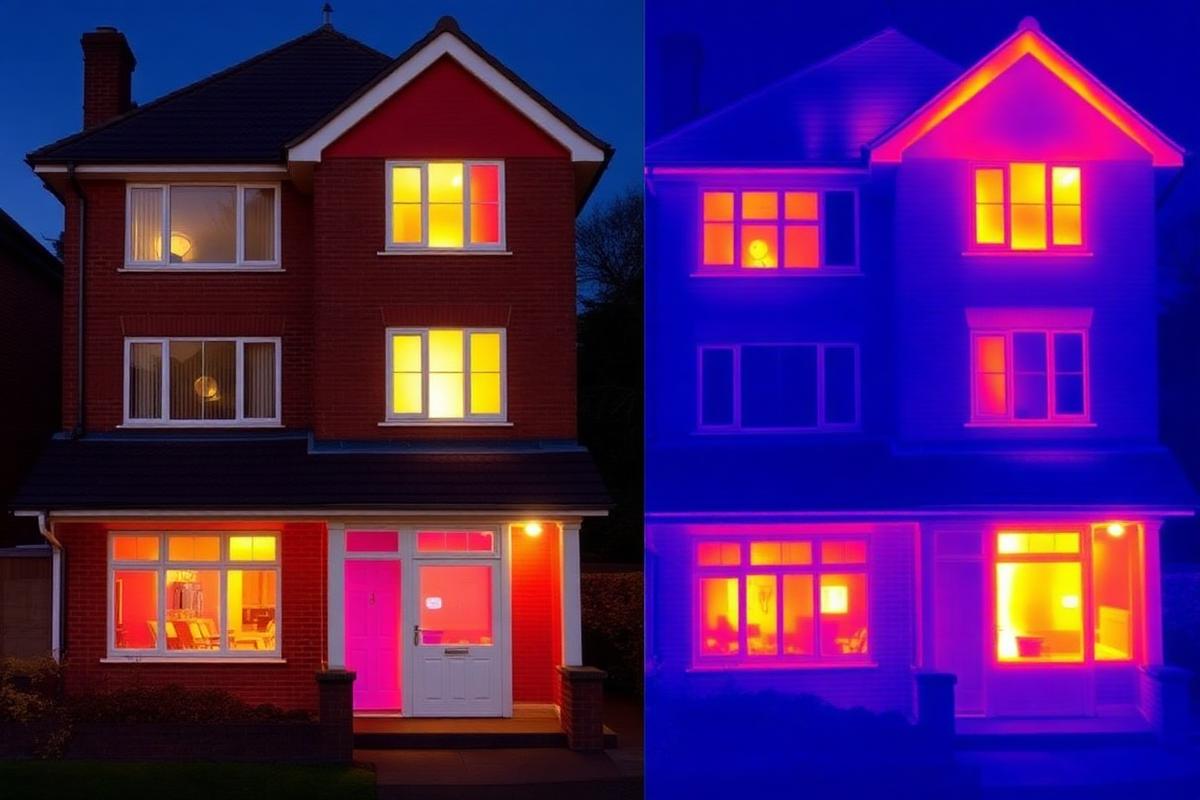
What is a heat loss survey?
A heat loss survey uses a high-resolution thermal imaging camera to measure the surface temperature of walls, ceilings, floors, windows and roofs. By comparing these temperatures against a normal thermal profile, we can see exactly where heat is escaping and why — even when the building looks fine from the outside.
We work from Wolverhampton (WV10) and survey right across the West Midlands, Staffordshire, Shropshire, Warwickshire and Worcestershire for homeowners, landlords, buyers, tenants and social housing teams who want to understand why a property is cold, expensive to heat or covered in condensation every winter. Because we do not sell insulation, PIV units on commission or remedial work off the back of the survey, the report reflects the readings and nothing else.
Heat loss in Midlands housing stock
Where your house loses heat depends heavily on when and how it was built, and the Midlands has some very distinct patterns. These are the ones we photograph week in, week out:
Black Country solid-wall terraces
Pre-1919 terraces across Bilston, Tipton, Wednesbury, Cradley Heath and Smethwick have no cavity at all. Thermal imaging shows the whole wall running cold, and the coldest bands are usually behind furniture and in the back bedroom — exactly where the mould appears.
Inter-war cavity semis
The 1930s semis that dominate Wolverhampton, Walsall, Dudley and north Birmingham were retro-filled with cavity insulation decades ago. We routinely find it slumped, leaving a cold band across the top third of the gable and cold patches around window reveals.
Post-war council stock
Non-traditional and system-built housing in Telford, Cannock, Redditch and parts of Stoke shows heavy cold bridging at concrete panel joints and joist ends. Social landlords use our reports as evidence when planning retrofit or answering damp and mould complaints.
Period and rural property
Solid stone and timber-framed houses around Shrewsbury, Ludlow, Bridgnorth, Lichfield, Worcester and Malvern lose heat through roof junctions, unlined chimney breasts and gaps at floor level — and cannot simply be wrapped in insulation without creating a damp risk.
Loft insulation that stops short
The single most common find in every Midlands town: insulation missing at the eaves, trodden flat around the hatch, or lifted and never replaced after loft boarding or a new boiler flue. Cheap to fix once you know where it is.
New-build estates
On newer estates around Telford, Rugby, Bromsgrove and Cannock we find missed insulation behind plasterboard, unsealed service penetrations and poor sealing at window reveals — usually still within the warranty period.
Heat loss surveys near you
Based in Wolverhampton, so most of the region is a short drive and there is no travel surcharge. We regularly survey in:
Not on the list? See all 69 towns we cover.
What a thermal imaging heat loss survey finds
Missing or displaced insulation
Thermal imaging shows gaps, compression, settlement and areas where insulation was never installed — particularly in lofts, cavity walls and behind ceilings.
Cold bridges and thermal bypasses
Joist ends, window reveals, lintels and steelwork often create cold bridges that cause condensation and black mould. We identify them precisely so they can be targeted.
Air leakage and draughts
Heat loss surveys locate hidden air paths around skirtings, floorboards, loft hatches, service penetrations and poorly sealed openings that increase heating bills.
Electrical and hot-spot checks
Thermal cameras also reveal electrical hot spots, underfloor heating faults and pipe leaks — giving you more than an energy snapshot in one visit.
When to book a heat loss survey
Heat loss is not just about energy bills. Persistent cold surfaces often lead to condensation and black mould. Book a heat loss survey if you recognise any of the following:
- High heating bills with no obvious cause
- Cold rooms, cold walls or persistent draughts
- Black mould or condensation in specific corners
- Before insulation or retrofit work is quoted
- To support grant, ECO or retrofit applications
- After cavity-wall or loft insulation with no improvement
How our heat loss survey works
Briefing
We discuss your concerns, heating patterns, recent improvements and the areas you want checked.
Thermal survey
We scan walls, ceilings, floors, windows, rooflines and service penetrations with a professional thermal imaging camera.
Moisture cross-check
Where cold spots indicate risk, we use calibrated moisture meters and hygrometers to check for condensation or hidden damp.
Written report
You receive a clear report with thermal images, temperature readings, identified issues and prioritised improvement recommendations.
Heat loss survey vs. damp survey
A heat loss survey is the right choice when your concern is cold rooms, high energy costs or efficiency. If you already have visible damp, mould patches, tide marks or a musty smell, a damp survey is usually the better starting point. We can also carry out a combined thermal and damp survey if both issues are present.
Frequently asked questions
What is a heat loss survey?
A heat loss survey uses a thermal imaging camera to measure surface temperatures and reveal where heat is escaping from a building. It shows missing insulation, cold bridges, air leaks and thermal bypasses that are invisible to the naked eye.
What does a heat loss survey find?
It finds missing or displaced loft and cavity insulation, cold bridges at joist ends and window reveals, draughts around doors and skirtings, thermal bypasses in suspended floors, and heat loss through single glazing or poorly fitted windows.
How much does a heat loss survey cost in Wolverhampton or Birmingham?
From £300 plus VAT for a typical West Midlands semi or terrace, up to around £600 for larger detached and period properties. We are based in Wolverhampton, so there is no travel surcharge anywhere in the Black Country, Birmingham, Staffordshire, Shropshire or Worcestershire. The fee is fixed before booking.
Which areas do you cover?
From our Wolverhampton base we cover Birmingham, Walsall, Dudley, West Bromwich, Stourbridge, Cannock, Stafford, Lichfield, Telford, Shrewsbury, Worcester, Kidderminster, Coventry, Stoke-on-Trent and 55 more towns across the Midlands, Shropshire and mid-Wales. Same-week appointments in most of them.
Why are Black Country houses so cold?
Much of the stock is pre-1919 solid-wall terrace with no cavity to insulate, or 1930s cavity semis where retro-fill insulation has slumped. Both show up immediately on thermal imaging, and both are behind most of the condensation and mould we are called out to in Bilston, Tipton, Wednesbury and Smethwick.
Do I need a heat loss survey or a damp survey?
A heat loss survey is best if your main concern is cold rooms, high bills or energy efficiency. If you already have damp patches, mould, tide marks or a musty smell, a damp survey is usually the right first step. We can combine both if needed.
Can thermal imaging see through walls?
No. Thermal imaging reads surface temperature, not what is behind the wall. However, temperature differences on the surface can accurately indicate missing insulation, air movement and cold bridging behind the plaster.
Is a heat loss survey worth it?
Yes. It gives you a targeted list of insulation and airtightness improvements, helps avoid wasted spend, and can support grant or retrofit applications by showing exactly where energy is being lost.
Book an independent heat loss survey
We cover residential properties throughout the UK. Call, WhatsApp or email for a fixed-fee quote tailored to your property size and the report you need.